

News & Publikationen
Unseren Publikationen
-

German Oncology Databases: Options and Assessment
Dieses Dokument gibt einen Überblick über verfügbare deutsche Datenquellen aus der Onkologie, die potenziell für Real-World-Evidence-Studien genutzt werden können. Es kommt zu dem Schluss, dass es keine ideale Datenquelle gibt, sondern dass die Studienziele ausschlaggebend dafür sind, ob Abrechnungsdaten oder onkologische EHR-Daten verwendet werden oder ob eine Aktenauswertung oder eine prospektive Beobachtungsstudie durchgeführt wird.
-
Monitoring the Burden of Lung Cancer in Germany: Trends in Incidence and Survival Using ZfKD Registry Data (2020–2023)
Objective: To describe recent trends in lung cancer incidence, staging, morphology, and survival outcomes in Germany using comprehensive population-based data from the German Centre for Cancer Registry Data (ZfKD) .
Methods: This retrospective analysis included all lung cancer cases diagnosed from 2020 to 2023 in individuals aged 18 years or older. Anonymized data were sourced from the ZfKD, which compiles mandatory cancer notifications across the German federal states. Variables analyzed included patient demographics, tumor characteristics (histological subtype, stage), and Kaplan-Meier-based survival estimates stratified by cancer subtype and stage.
Results: Stage IV was the most common at diagnosis (41% in NSCLC, 59% in SCLC). Median survival was 12.8 months for NSCLC and 8.1 months for SCLC, dropping to 6.5 and 6.8 months, respectively, in stage IV disease.
-

Trends in Epidemiology and Mortality of Patients with Bladder Cancer in Germany: A Retrospective Study Using German Claims Data
Objective: This research aims to estimate the incidence/prevalence of BC in Germany and to describe trends in mortality in the last eleven years.
Methods: Based on anonymized claims data from 19 German sickness funds with 6.3 million insured persons provided by GWQ ServicePlus AG, patients with at least two outpatient or one inpatient BC diagnosis (ICD-10-GM: C67) were identified as BC cases. BC incidence was defined as newly diagnosed after a 24-month baseline period of continuous insurance and without any BC diagnosis. Cumulative BC incidences were assessed for the years 2012, 2018, and 2023. Point prevalences were calculated for January 1st, 2013, January 1st, 2019, and January 1st, 2024. Incidence and prevalence were extrapolated (age- and gender-standardized) to the overall German population of the respective year. Standardized mortality rates for the years 2012, 2018, and 2023 were evaluated in cross-sectional BC samples (BC prevalent and alive on January 1st of the respective year). The incidence in 2023 was compared with nationwide registry data from 2022 (Centre for Cancer Registry Data (ZfKD) located at Robert Koch Institute (RKI)).
Results: The cumulative incidence in the observed population was 0.040% in 2012 (0.048% standardized to the German population), 0.033% in 2018 (0.36% standardized), and 0.036% in 2023 (0.040% standardized). The point prevalence was 0.191% on January 1st, 2013 (0.236% standardized to the German population), 0.195% on January 1st, 2019 (0.224% standardized), and 0.213% on January 1st, 2024 (0.235% standardized). The mean age of the prevalent populations was decreased from 66.7 to 65.6 years; the proportion of female BC patients also decreased from 26.2% on January 1st, 2013, to 24.3% on January 1st, 2024. The mortality in the population of BC prevalent patients was 6.10% in 2012 (5.640% extrapolated to the German population), 6.70% in 2018 (5.848% extrapolated), and 6.69% in 2023 (5.969% extrapolated).
-
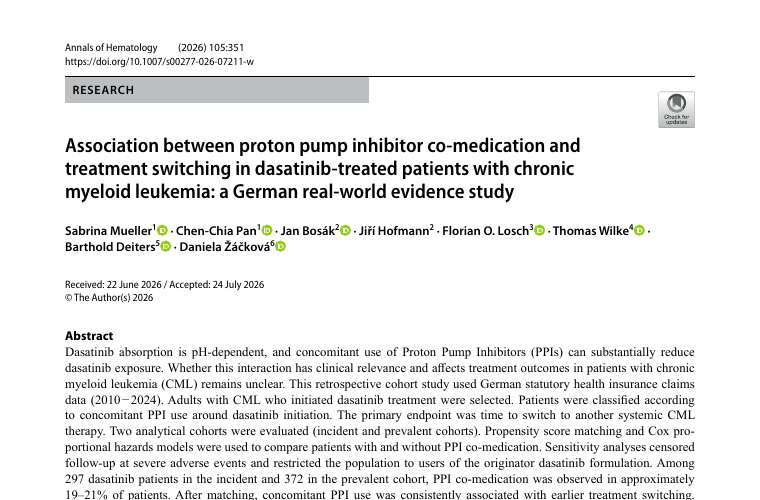
Association between Proton Pump Inhibitor Co-medication and Treatment Switching in Dasatinib-treated Patients with Chronic Myeloid Leukemia: A German Real-World Evidence Study
Objective: To assess whether concomitant proton pump inhibitor (PPI) use affects treatment outcomes in dasatinib-treated patients with chronic myeloid leukemia (CML).
Methods: Retrospective cohort study using German statutory health insurance claims data (2010–2024). Adults initiating dasatinib were grouped by PPI co-medication; propensity score matching and Cox models compared time to switch to another systemic CML therapy in an incident (n = 297) and a prevalent (n = 372) cohort.
Results: PPI co-medication was observed in approximately 19–21% of patients. After matching, concomitant PPI use was consistently associated with earlier treatment switching, reaching statistical significance in the prevalent cohort (HR 1.87; 95% CI 1.18–2.95; p = 0.008).
Mueller S, Pan C-C, Bosák J, Hofmann J, Losch FO, Wilke T, Deiters B, Žáčková D. Annals of Hematology (2026) 105:351.
-
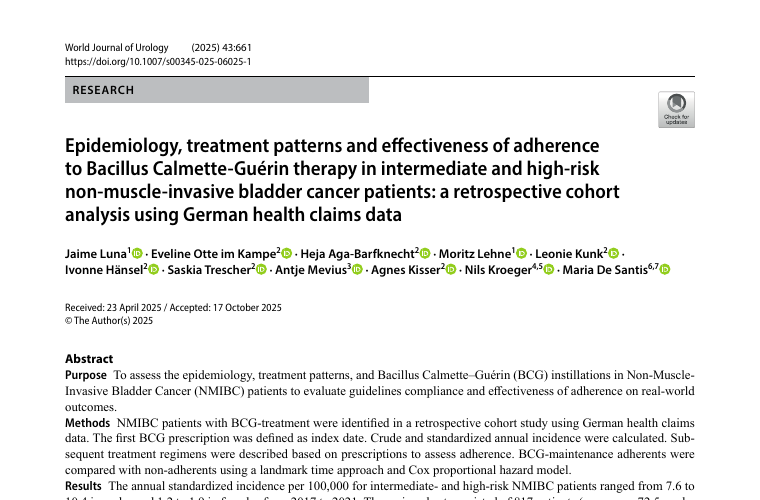
Epidemiology, Treatment Patterns and Effectiveness of Adherence to Bacillus Calmette-Guérin Therapy in Intermediate and High-risk Non-muscle-invasive Bladder Cancer Patients: A Retrospective Cohort Analysis Using German Health Claims Data
Objective: To assess the epidemiology, treatment patterns and BCG instillations in intermediate- and high-risk NMIBC patients and to evaluate guideline compliance and the effectiveness of BCG adherence on real-world outcomes.
Methods: Retrospective cohort study using German health claims data, with the first BCG prescription as index date. Standardized incidence was calculated, and BCG maintenance-adherent patients were compared with non-adherent patients using a landmark approach and Cox models.
Results: Standardized annual incidence (2017–2021) was 7.6–10.4 per 100,000 in males and 1.2–1.9 in females. Of 817 patients, only 28% continued BCG maintenance at 24 months. Adherence was associated with a lower risk of advanced treatment (aHR 0.49) and disease progression (aHR 0.65).
Luna J, Otte im Kampe E, Aga-Barfknecht H, et al. World Journal of Urology (2025) 43:661.
-
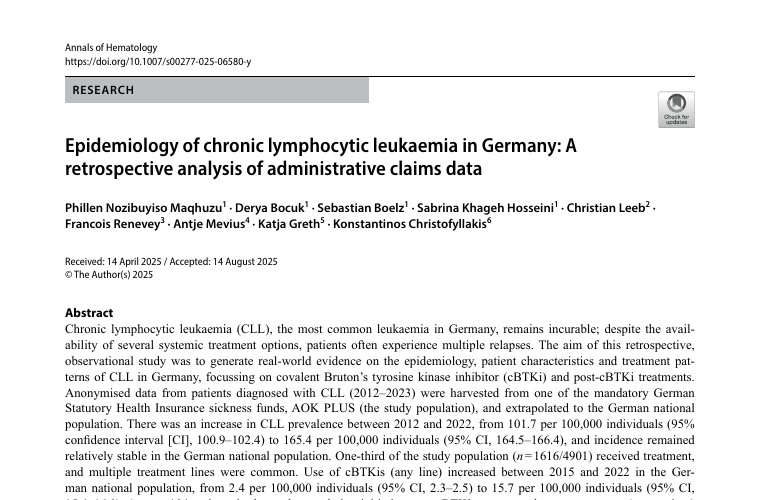
Epidemiology of Chronic Lymphocytic Leukaemia in Germany: A Retrospective Analysis of Administrative Claims Data
Objective: To generate real-world evidence on the epidemiology, patient characteristics and treatment patterns of CLL in Germany, focusing on covalent BTK inhibitors (cBTKi) and post-cBTKi treatment.
Methods: Retrospective analysis of anonymised AOK PLUS claims data (2012–2023), extrapolated to the German national population.
Results: CLL prevalence rose from 101.7 to 165.4 per 100,000 (2012–2022), while incidence remained relatively stable. One third of patients (1,616/4,901) received treatment; cBTKi use increased from 2.4 to 15.7 per 100,000 (2015–2022). After cBTKi, re-treatment with a cBTKi (53.8%) and anti-CD20 antibodies (41.3%) were most common.
Maqhuzu PN, Bocuk D, Boelz S, et al. Annals of Hematology (2025).
-
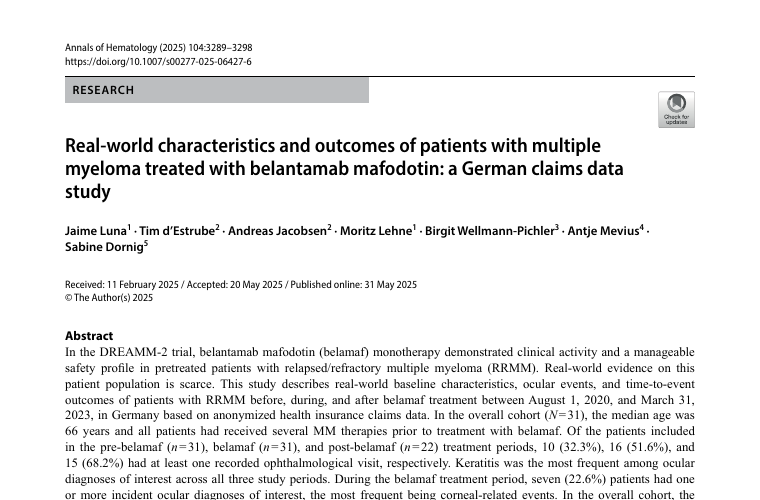
Real-world Characteristics and Outcomes of Patients with Multiple Myeloma Treated with Belantamab Mafodotin: A German Claims Data Study
Objective: To describe real-world baseline characteristics, ocular events and time-to-event outcomes of patients with relapsed/refractory multiple myeloma (RRMM) treated with belantamab mafodotin (belamaf).
Methods: Anonymized German health insurance claims data (August 2020 – March 2023), analysing the periods before, during and after belamaf treatment.
Results: 31 heavily pretreated patients (median age 66). During belamaf treatment, 22.6% had incident ocular diagnoses of interest, mostly corneal-related events. Real-world PFS was 4.3 months and OS 12.3 months.
Luna J, d’Estrube T, Jacobsen A, et al. Annals of Hematology (2025) 104:3289–3298.
-
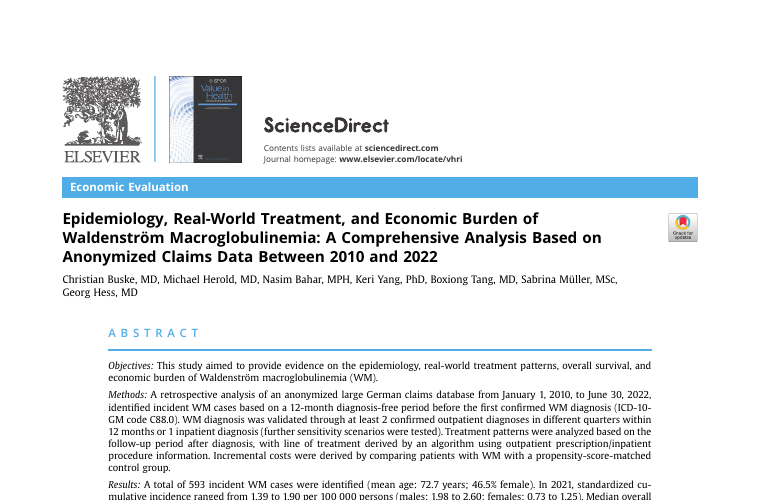
Epidemiology, Real-World Treatment, and Economic Burden of Waldenström Macroglobulinemia: A Comprehensive Analysis Based on Anonymized Claims Data Between 2010 and 2022
Objective: To provide evidence on the epidemiology, real-world treatment patterns, overall survival and economic burden of Waldenström macroglobulinemia (WM) in Germany.
Methods: Retrospective analysis of a large anonymized German claims database (January 2010 – June 2022); incremental costs were derived versus a propensity-score-matched control group.
Results: 593 incident WM cases (mean age 72.7 years). In 2021, standardized cumulative incidence ranged from 1.39 to 1.90 per 100,000. Median OS was 7.9 years. Nearly 70% initially followed a watch-and-wait approach; rituximab-based regimens were most common. Costs were driven mainly by medication and inpatient care.
Buske C, Herold M, Bahar N, Yang K, Tang B, Müller S, Hess G. Value in Health Regional Issues (2025) 50:101162.
-
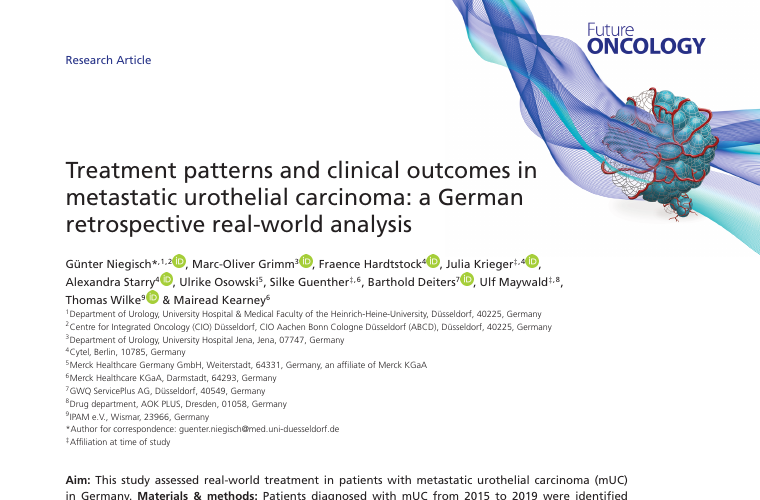
Treatment Patterns and Clinical Outcomes in Metastatic Urothelial Carcinoma: A German Retrospective Real-World Analysis
Objective: To assess real-world treatment of patients with metastatic urothelial carcinoma (mUC) in Germany.
Methods: Patients diagnosed with mUC from 2015 to 2019 were identified in two German claims databases (AOK PLUS and GWQ).
Results: Of 3,226 patients, only 39.9% received systemic treatment within 12 months of diagnosis (platinum-based chemotherapy: 64.2%). Younger age, male sex, less comorbidity and more recent diagnosis were associated with treatment. Median OS from diagnosis in treated patients was 13.7–13.8 months.
Niegisch G, Grimm M-O, Hardtstock F, et al. Future Oncology (2024) 20(19):1351–1366.

German oncology databases: options and assessment for real-world evidence
Our whitepaper gives an overview of German oncology data sources for real-world evidence studies – and how to choose the right one.
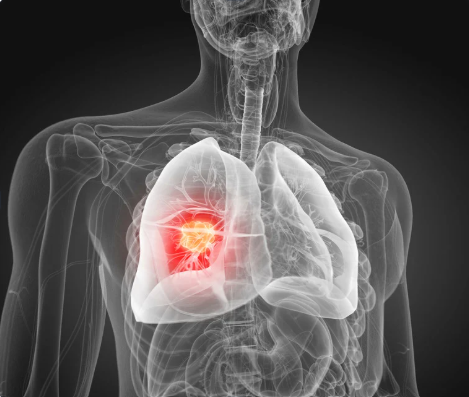
Lung cancer in Germany: incidence and survival trends from ZfKD registry data (2020-2023)
Population-based ZfKD registry data show that most lung cancers in Germany are still diagnosed at stage IV, with poor survival in advanced disease.

Bladder cancer in Germany: trends in incidence, prevalence and mortality
OncoCase analysed claims data from 6.3 million insured persons to track bladder cancer incidence, prevalence and mortality in Germany over the last decade.
Metastatic urothelial carcinoma: fewer than half of patients receive systemic treatment
Real-world data from two German claims databases show that fewer than half of patients with mUC receive systemic treatment within 12 months.
Waldenström macroglobulinemia in Germany: incidence, treatment and costs
A comprehensive claims-data analysis shows rising WM incidence and a substantial economic burden – even though most patients start with watch-and-wait.
Belantamab mafodotin in real-world practice: ocular care matters
German claims data describe patients with relapsed/refractory multiple myeloma treated with belamaf – and highlight the importance of ophthalmological monitoring.
CLL in Germany: rising prevalence and growing use of BTK inhibitors
A claims-data study shows that CLL prevalence in Germany rose by more than 60% between 2012 and 2022, alongside growing use of BTK inhibitors.
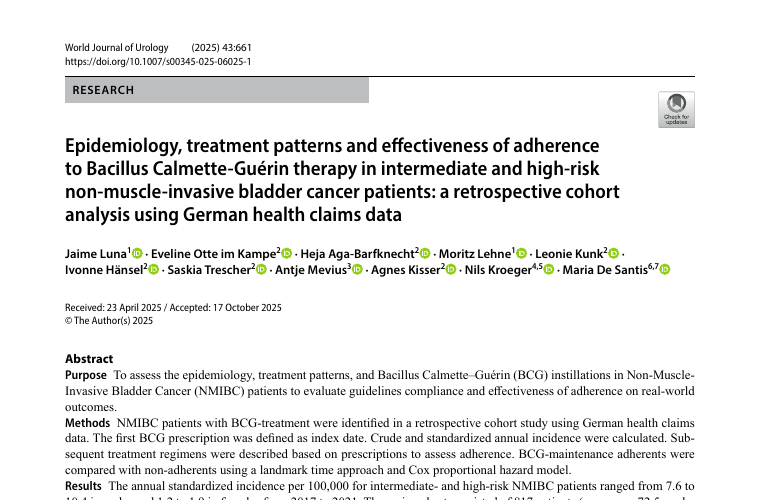
BCG adherence in NMIBC: real-world data show room for improvement
German claims data show that only 28% of intermediate- and high-risk NMIBC patients remain on BCG maintenance at 24 months – and that adherence pays off.
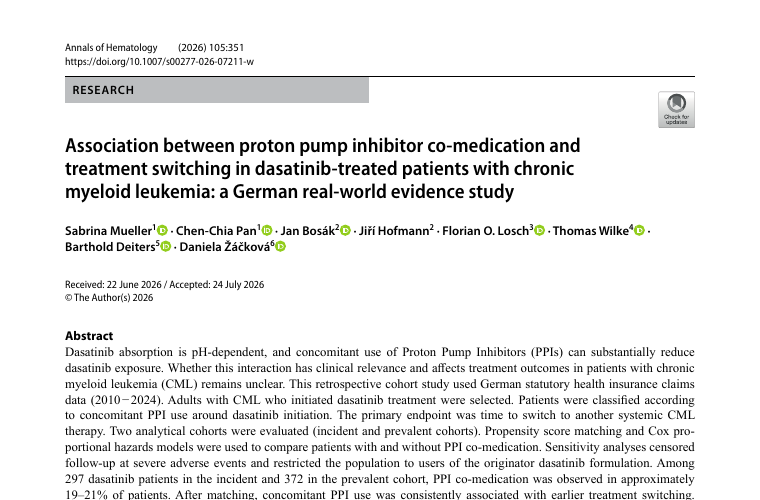
PPI co-medication linked to earlier treatment switching in dasatinib-treated CML patients
New real-world evidence from German claims data suggests that combining dasatinib with proton pump inhibitors is associated with earlier treatment switching in CML.

Sabrina Müller präsentiert Ergebnisse einer Analyse auf Basis von Krebsregisterdaten auf dem Annual ISPE Meeting 2024 in Berlin
In dieser retrospektiven Analyse wurden Patienten mit fortgeschrittenem nicht-kleinzelligem Lungenkarzinom (aNSCLC) aus dem Sächsischen Krebsregister untersucht. Von 2015 bis 2019 wurden 4.858 Patienten mit NSCLC im Stadium IIIB, IIIC und IV eingeschlossen. Die häufigsten Pathologien waren Adenokarzinom und Plattenepithelkarzinom.

Multinationale Real-World Data Studie zur Entwicklung der Überlebensraten von Patienten mit fortgeschrittenem nicht-kleinzelligen Lungenkarzinom (aNSCLC) seit 2010 in Deutschland, USA, und Kanada
Prof. Dr. Thomas Wilke und Sabrina Müller aus dem OncoCase-Team haben zusammen mit Klinikern und Gesundheitsökonomen aus Deutschland, USA und Kanada eine multinationale retrospektive Versorgungsforschungsstudie durchgeführt; die Ergebnisse wurden im Februar 2024 veröffentlicht:

Welche PI-basierten Kombinationstherapien präferieren Patienten?
Diese Frage haben Mitglieder des OncoCase-Teams im Rahmen eines Discrete-Choice-Experimentes (DCE) untersucht.

Behandlung und Überleben von Patienten mit fortgeschrittenem nicht-kleinzelligen Lungenkrebs - Eine retrospektive Analyse deutscher Krankenkassendaten
Prof. Dr. Thomas Wilke stellte sich gemeinsam mit Klinikern und Gesundheitsökonomen den Herausforderungen von Analysen auf Basis von Abrechnungsdaten.